

“The buck stops here.” Sign on President Harry S. Truman’s desk
A payment has a lot of people in it.
There’s you, obviously. The shop. The shop’s bank. The card scheme whose logo sits on your card. The bank that issued it. Somewhere further back, a regulator, a government department, and these days possibly a stablecoin company or an AI agent buying things on your behalf. On a good day all of them play their part and nobody notices the music.
On a bad day, somebody has to pay. And it’s remarkable how often it turns out to be the same somebody.
Over the past four weeks I’ve written about six quite different stories on LinkedIn. Offline card payments. A legal fight over card fees. Stablecoins. The £99 limit at the petrol pump. HMRC’s power to take tax straight from bank accounts. A £100 energy payment from the Budget. Different players, different rules, different headlines.
Same ending every time. The bank that issued the card, or holds the account, ends up holding the bill.
This first issue of The Money Orchestra is about why. And about what happens when the player everyone relies on to pay starts to wonder why it keeps being them.
Six stories, one ending
The network goes down. In October Mastercard announced offline card payments for Europe. If a terminal loses its connection, the chip on your card can approve a payment of up to €200 against limits your bank has stored on it. New cards must carry it from February 2027. Lovely for resilience. But nobody checks your balance while the network is down, so the account can go overdrawn. Who covers that? The announcement didn’t say. The bank set the limits, so the bank will.
The fees go up. A new claim at the Competition Appeal Tribunal, on behalf of about 126,000 UK businesses, says Visa and Mastercard overcharged them after Brexit. Before Brexit, an online payment at a UK business with a card from an EU country counted as European and was capped like any other. Afterwards it became an “inter-regional” payment, and the fee on consumer cards went from 0.2% to 1.15% for debit and from 0.3% to 1.5% for credit. The headlines blame the schemes. Follow the money and it goes to the issuing banks, because interchange is paid to the bank that issued the card. Keep that thought. It comes back later.
The disruptor joins the band. Stablecoins were sold as a way around the card networks. In August Mastercard completed a $1.8bn purchase of BVNK, a stablecoin infrastructure firm, and in October the two launched cards that spend stablecoin balances in more than 130 countries. Spend one and it travels over Mastercard’s network, under Mastercard’s rules, with interchange paid to whoever issued the card. The new money ends up behind the old card.
The pump stops at £99. Pay at the pump works on a hold. The forecourt picks the amount, within a ceiling Visa raised to £100 in early 2022, and the bank freezes it while you fill up. With diesel around £2 a litre, a 55-litre tank costs about £110 and no longer fits. And the bank carries the timing risk. Release the hold too early and the customer spends the money before the fuel bill arrives. The bank pays it anyway. Some accounts aren’t allowed to go overdrawn at all, which is the bank’s problem and nobody else’s.
The taxman calls. HMRC can already take unpaid tax straight from bank accounts, with safeguards: a debt of at least £1,000 and at least £5,000 left behind. The Budget on 28 October added the next step: from 2029, regular deductions from the accounts of people and companies who keep ignoring smaller debts, up to £5,000 for individuals and £10,000 for companies. HMRC decides who owes. The bank finds the accounts, freezes the money and answers the phone.
The government sends £100. The Budget gave about 20 million households in council tax bands A to D in England a £100 energy payment. Pay council tax by Direct Debit and it arrives automatically. Everyone else must hand their council their bank details. In 2022, the £150 council tax rebate worked the same way, and councils spent the spring warning people about fake texts asking for exactly those details. This time nobody waited for spring. Within days of the Budget, warnings about fake £100 energy payment texts were already doing the rounds. When someone is tricked, the refund usually comes from the banks.
Six stories. A card scheme, a tribunal, a stablecoin firm, a forecourt, the taxman and a council. Every one of them ends at the bank.
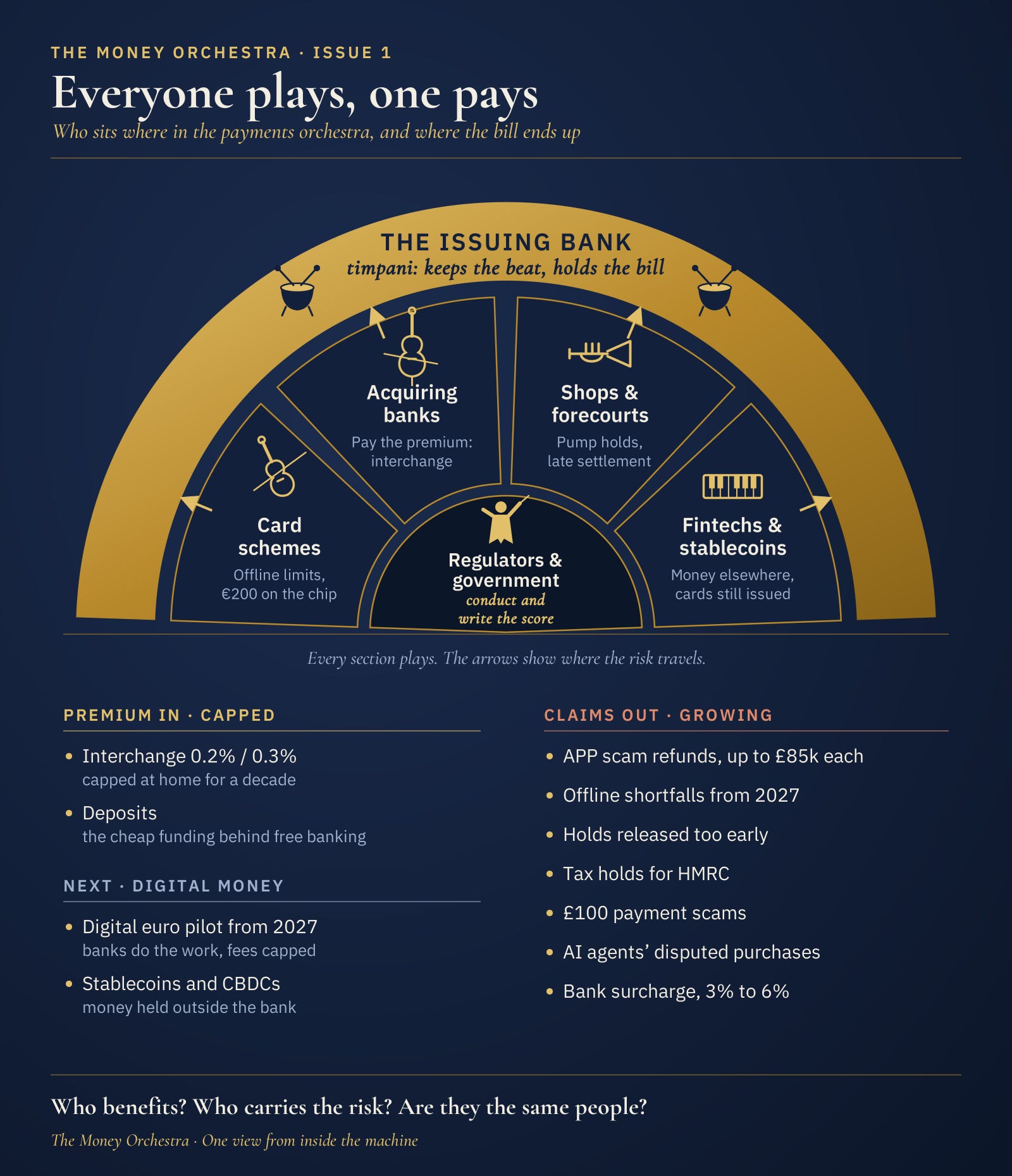
Why it’s always the bank
None of this is a conspiracy. It’s geometry.
The bank sits closest to the customer. It holds the account, the card, the contact details, the money itself. When something goes wrong at the till, on a forecourt or in a fraudster’s text message, the bank is the one party everybody can reach. The shop doesn’t know you. The scheme has never met you. The taxman would rather not. Your bank has your phone number and, crucially, your balance.
So when a regulator needs someone to reimburse a fraud victim quickly, it reaches for the bank. When a government wants to pay 20 million households, or collect from a few hundred thousand, it reaches for the bank. When a scheme designs a clever offline feature, the risk rules flow downhill to the bank, because the bank set the limits on the chip.
There’s a second reason, less flattering. Banks are regulated, solvent and easy to find. That makes them the ideal party to hold liability. Not because they caused the problem. Because they can pay for it and can’t easily walk away.
Call it the involuntary backstop. Every orchestra needs someone at the back keeping time while everyone else gets the applause. In payments, that’s the issuer.
The insurance policy nobody wrote
Here’s the bit that rarely makes the headlines. The issuer isn’t doing all this for free. It’s paid, in a roundabout way, through interchange.
Every time you pay by card, the shop’s bank pays a small fee to the bank that issued your card. For everyday consumer cards it’s capped at 0.2% for debit and 0.3% for credit, but only inside each zone. UK cards at UK shops get the UK cap. Cards from EU and EEA countries get the EU cap anywhere inside the EEA, even across borders. Step outside your zone and the caps fall away: a non-European card used online at a European shop pays up to 1.15% or 1.5%, and since Brexit, so does a European card online at a UK shop. On a £50 shop at home, that’s 10p on debit.
Most people think of interchange as a toll. I think it’s closer to an insurance premium. The issuer collects it on every transaction and, in return, covers a remarkable list of things that might go wrong. Fraud on the card. Credit losses. Customers who dispute a payment. Offline approvals that bounce. Holds released too early. Scam victims who need refunding. The cost of the call centre that takes the angry calls.
Nobody ever wrote that policy down. There’s no document saying “in exchange for 0.2%, the issuer shall absorb the following”. It just accumulated, one rule and one incident at a time, until the issuer became the insurer of last resort for the whole payment chain.
Which explains the interchange fight from earlier. When Visa raised cross-border fees and Mastercard followed six months later, that wasn’t simple greed. The schemes compete for merchants and issuers alike, and interchange is how they win the issuers. The premium went up because the scheme wanted more banks writing the policy.
That’s not an excuse. Merchants pay the premium in the end, and through them, all of us. But it changes the question. Not “why are the fees so high?” but “what are the fees buying, and who decided?”
The squeeze
An insurer can live with almost any risk, as long as it sets the premium. The issuer can’t.
The premium is fixed. Domestic interchange in the UK has been capped at 0.2% and 0.3% for a decade. In January the High Court confirmed the regulator can cap the cross-border fees too. The price of the policy doesn’t move.
The claims, on the other hand, keep arriving.
Scam reimbursement. Since October 2024, UK payment firms have had to reimburse most victims tricked into sending money by Faster Payments or CHAPS, up to £85,000 a claim, with the sending and receiving banks splitting the cost 50:50. In the first year, 88% of the money claimed was paid back, according to the regulator. Across all APP fraud in 2025, including cases outside the scheme, losses came to £576m and £354m went back to victims. Most of the fraud started on online platforms and phone networks. The refunds come from the banks.
Offline mandates. From 2027, the offline shortfall becomes a standing risk on every new Mastercard in Europe.
AI agents. As software starts buying things on our behalf, someone will have to answer for the purchase the customer says they never meant to make. Have a guess who’s first in line.
Public duties. Fraud prevention, sanctions screening, economic crime checks, tax collection, and now distributing government money. Each is defensible on its own. Together they make the bank account a tool of the state, with the running costs sitting at the bank.
And the bill for being a bank. The Budget also raised the bank surcharge on profits from 3% to 6% for 15 months from January 2027.
None of these is unreasonable on its own terms. Victims should be refunded. Payments should work in a blackout. Tax should be paid. But each one adds a clause to a policy whose premium nobody is allowed to raise.
The next squeeze: digital money
There’s a bigger change coming, and it doesn’t add a clause. It goes after the thing that pays for the whole policy.
Banks don’t live on interchange. They live on deposits. Your current account balance is cheap funding, and cheap funding is what pays for free banking, the card, the app and that call centre. Take the deposits away and the sums behind everything above stop adding up.
That’s where central bank digital currencies come in. The usual story is that a digital euro or a digital pound would let the central bank deal with the public directly and cut the banks out. The actual designs are cleverer than that, and in some ways worse for issuers.
The digital euro, which the ECB wants to pilot from the second half of 2027 with 36 banks and payment firms, and could issue from 2029, is intermediated. The central bank issues the money. Banks and payment firms hand it out, onboard customers, check identities, deal with fraud and answer the questions. EU lawmakers want limits on how much each person can hold, precisely to stop deposits draining out of banks. And both the European Parliament and EU governments want the fees banks can charge for all that work capped from day one.
Read that again with the rest of this essay in mind. The bank does the work. Someone else sets the premium. And some of the deposit leaves anyway, up to the holding limit.
The UK hasn’t decided yet. The Treasury says it will announce a decision on a retail digital pound by the end of this year. The Bank of England says it’s in no rush, and it’s weighing whether regulated sterling stablecoins could do the job instead. It expects those to operate from 2027, with an initial cap of £40bn for each large coin. Different label, same question. Stablecoin balances also sit outside the bank. And as Mastercard’s BVNK deal shows, when people want to spend them, they still reach for a card. The money sits elsewhere. The card, and its duties, stay in the chain.
So the next squeeze isn’t banks being cut out. It’s banks being kept in, doing the job, without the deposit that paid for it.
When the insurer reprices
So what does an insurer do when the premium is capped, the claims keep growing and the reserves start walking out of the door?
It doesn’t announce anything. It just adjusts. And this is where it stops being an industry problem and starts reaching your money.
Free banking gets less free. UK current accounts are free largely because deposits and interchange pay for them. Squeeze both and the costs have to reappear somewhere. Fees on things that used to be free. Monthly charges dressed up as “premium” accounts. Worse rates on the savings that are left.
Features get trimmed. Cashback, card perks, generous limits, quick fraud refunds with no questions asked. All of these are paid for out of the same pot. When the pot shrinks, the extras go first.
Limits stay low. Remember the pump stuck at £99, or the offline payment capped at €200? Every limit is the bank deciding how much risk it can afford to carry for the premium it’s paid. If the risk grows and the premium doesn’t, limits rise slowly, if at all.
Some customers become less welcome. This is the uncomfortable one. If every customer carries a share of fraud, overdraft and compliance risk, and the bank can’t price that risk, it starts choosing who to take on. Thin credit files, newcomers to the UK, small businesses with lots of transactions, people in financial difficulty. The ones who most need a bank account can find it hardest to get a good one.
None of this happens overnight. That’s what makes it easy to miss. Nobody sends a letter saying “due to the cumulative burden of unpriced liabilities, your account is now slightly worse”. It just drifts.
My point is
The payment system feels cheap because one player keeps absorbing, without much fuss, the cost of everything that goes wrong.
That isn’t a plea for sympathy for banks. Banks are big, well capitalised and perfectly able to make their own case. It’s a point about design. A system in which everyone benefits and one party pays only works for as long as that party keeps paying. Cap its income, add to its duties, take its deposits, and sooner or later it does what any insurer does. It reprices, it restricts, or it steps back.
The better question for regulators, governments and schemes alike is a simple one to ask every time a new rule arrives. Who benefits from this? Who carries the risk? And are they the same people?
When they are, the system holds. When they aren’t, the bill doesn’t disappear. It just turns up later, in a smaller account, a higher fee or a door that’s harder to open.
The buck has to stop somewhere. It would help if, now and then, we chose where.
That’s one view from inside the machine. If you see it the same way, or differently, hit reply. I read everything, and the best disagreements become future issues.
If this made you think, forward it to a colleague who’d enjoy it.
Dirk
Views are my own and not those of any employer, past or present.